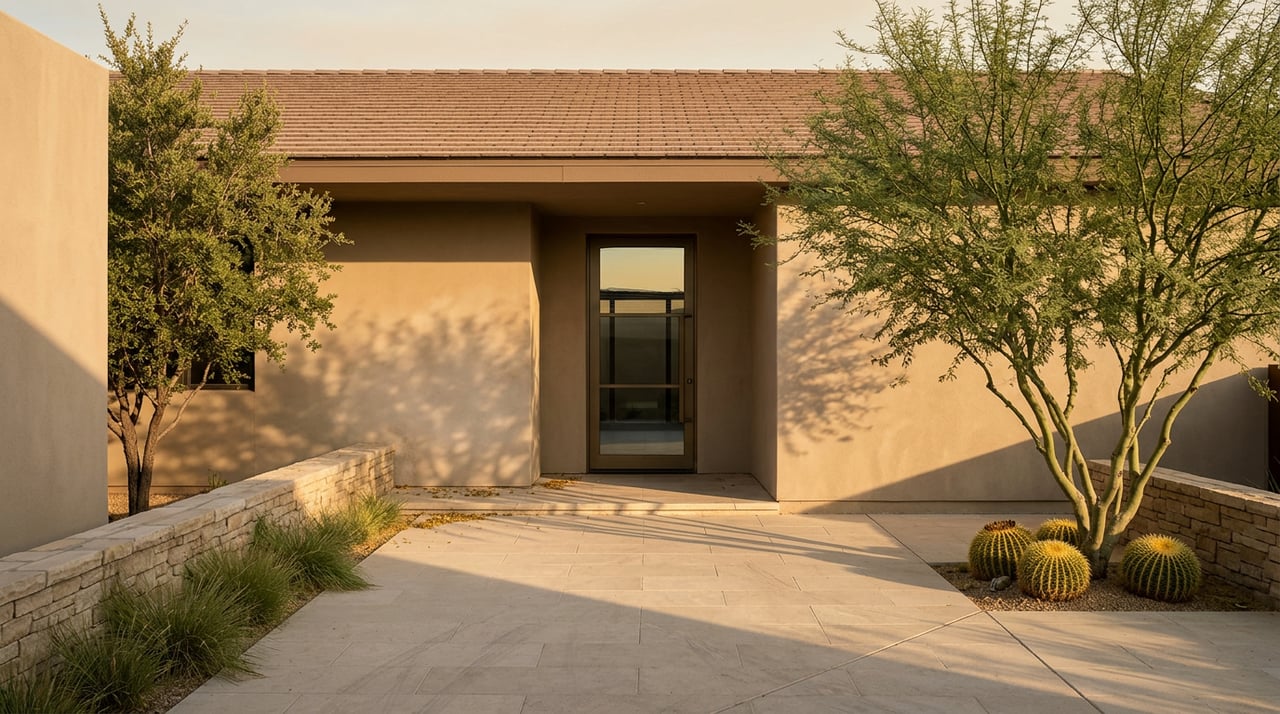
Scottsdale Can't Ban Your Short-Term Rental. Your HOA Still Can.
September 24, 2026
September 24, 2026
Arizona law is unusually protective of the right to rent a property short term. State legislators settled that question years ago, and Scottsdale, despite trying harder than almost any other city in the state to tighten the rules, has never been allowed to ban vacation rentals outright. That protection is real. It is also the reason so many buyers stop reading the fine print one layer too early.
The city license Scottsdale requires and the rules your homeowners association enforces are answering two completely different questions, and a yes from one tells you nothing about the other. A condo can hold a fully valid Scottsdale short-term rental license and still be in violation of its own community's governing documents the day the owner books a first guest. The city's application never asks to see your CC&Rs, because the city has no authority over them. That gap is where investors who assumed "legal in Scottsdale" meant "legal in this building" find out otherwise, usually from a cease-and-desist letter rather than a phone call.
Scottsdale's licensing framework, adopted under Ordinance 4566, is thorough on the things it controls. To operate a rental under 30 days, an owner needs a city license renewed annually for $250, an Arizona Transaction Privilege Tax number, at least $500,000 in liability insurance, and a designated emergency contact. Within 30 days of the license being issued, the owner has to notify every adjacent single-family property and any home directly or diagonally across the street, or every unit on the same floor in a multi-family building. Operate without the license and the city can fine you starting around $1,000 a month, a penalty that keeps accruing rather than resetting.
Ordinance 4719 goes a step further and closes a specific loophole: a short-term rental cannot be used as a commercial event venue. Weddings, corporate retreats, and large parties booked through a listing are out, and enforcement in practice usually starts with a neighbor's complaint about a gathering that got loud.
None of that paperwork touches your HOA. The application does not ask whether your community's CC&Rs permit short-term use, does not request a copy of the HOA's rental policy, and does not check whether a rental resolution passed by the board six months before you bought restricts terms to 30 days or longer. The city's job, as defined by its own ordinance, stops at licensing and public safety. Everything your community privately agreed to when it recorded its governing documents sits entirely outside that process.
The license and the HOA rulebook are two separate systems built to answer two separate questions. Passing one proves nothing about the other.
The reason the city's authority stops where it does traces back to two pieces of state legislation. In 2017, Arizona's SB1350 required cities like Scottsdale to allow short-term and vacation rentals in residential districts and limited local regulation to protecting public health and safety and enforcing existing zoning, a real shift from the era when the city had treated short-term rentals as travel accommodations restricted to hotel and resort zones. That law is why Scottsdale cannot tell an owner they simply are not allowed to rent.
Five years later, SB1168 gave cities the tools to regulate how those rentals operate rather than whether they can exist at all: licensing, insurance minimums, emergency contact requirements, and escalating enforcement against nuisance properties, including the ability under repeated verified violations to bar a specific property from short-term use going forward. That's the law behind Ordinance 4566's teeth.
Both statutes regulate the relationship between a city government and a property owner. Neither one mentions homeowners associations, because an HOA is not a government body. It is a private contract every owner in that community signed onto when they took title, recorded against the property itself. State preemption law constrains what a city can demand. It has nothing to say about what a community's own recorded documents can require of its members. That is the structural reason the two systems never talk to each other, and it is why the license alone was never designed to be the final word.
This friction is not evenly distributed across the city. It concentrates in exactly the product types where HOAs are strongest: certain buildings and communities within Old Town Scottsdale, particularly newer condo developments, along with some communities within Gainey Ranch and McCormick Ranch, commonly restrict rental terms to 30 days or longer, or prohibit short-term rentals outright, through their own CC&Rs or a separately adopted rental policy. A unit in one of these buildings can meet every requirement in Ordinance 4566 and still be a non-starter as an investment, because the community's own rulebook already closed the door.
Custom-lot properties without an HOA remove this particular obstacle entirely, since there is no association rulebook to conflict with the city's license. That does not mean the search ends at zoning. A title search can still turn up a deed restriction recorded against an individual parcel, so the absence of an HOA is a simplification, not a guarantee.
The practical takeaway for anyone evaluating Scottsdale as a short-term rental market is that product type now matters as much as location. Two properties three blocks apart, one a condo inside a rental-restrictive HOA and one a detached home with no association at all, can sit at the same price point and represent two entirely different investment theses.
A standard HOA disclosure package tells you an association exists. It rarely settles the short-term rental question on its own, because the actual restriction often lives in a separate rental policy or board resolution rather than the master CC&Rs, and that kind of policy is frequently amendable by a board vote rather than a full owner vote. Before an offer goes in on any property where a short-term rental strategy matters to the numbers, the documents worth pulling are:
That last point matters because a rental policy adopted by board vote can also be tightened by board vote after you close. A yes today is not a permanent yes, and the only way to know how easily that yes could change is to see how the current rule was adopted in the first place.
Assuming a property passes both the city and the HOA test, the ongoing obligations are real but manageable. Short-term rental income in Scottsdale carries a combined transient tax load of roughly 14.27 percent, layered across state, county, and city rates. It is a pass-through collected from the guest, and major platforms typically collect and remit most of it automatically, though the owner still needs an individual TPT license and remains responsible for confirming everything was filed correctly.
Insurance is the other line item that surprises first-time hosts. A standard homeowner's policy generally excludes business use, so it will not cover a guest injury on the property even though the city's $500,000 liability minimum is satisfied through a policy or platform-provided coverage. Most owners end up adding an STR-specific policy or rider on top of whatever the platform provides.
On timing, county rental registration is typically same-day online, a TPT license usually takes a few business days through the Arizona Department of Revenue, and the city license generally takes one to two weeks once the TPT number, insurance proof, and contact information are submitted, with neighbor notification due within 30 days after the license is issued. None of that is fast enough to shortcut if the HOA question surfaces after you already own the property.
If my HOA changes its rental policy after I already have a city license, does the license protect me? No. The two are unrelated documents. A Scottsdale STR license stays valid on the city's side even if your HOA later restricts or bans short-term rentals in your community, and the obligation to follow your HOA's current rules sits with you regardless of what the city has on file.
Is the HOA override the only surprise, or are there others? It is the one that comes up most often in practice, largely because buyers assume the state's protection of short-term rental rights means the paperwork is straightforward. The event-venue restriction under Ordinance 4719 is a second one worth knowing if any part of the investment plan involved hosting larger gatherings rather than standard overnight stays.
Does buying a property with no HOA solve this completely? It removes the association layer, but a title search can still reveal a deed restriction recorded against that specific parcel, so confirming clean title on rental use is still worth doing even without a board or CC&Rs in the picture.
If a short-term rental strategy is part of why you're looking at a specific Scottsdale property, the CC&Rs and the HOA's rental policy deserve the same scrutiny as the comps before you write the offer. Camille Kennard works with investors and relocating buyers across Scottsdale who need that answer before it becomes a closing-week surprise, not after.
Stay up to date on the latest real estate trends.

Whether you're a first-time home buyer, looking to expand your investment portfolio, or just seeking advice on becoming more financially savvy through real estate, I'm here to help. I believe that with the right knowledge and guidance, everyone can achieve their real estate dreams and create a legacy for their loved ones, Contact Camille today!

Camille Kennard
4222 N Marshall Way Scottsdale AZ 85251